Occultation and Revelation
Idols, Eve and the Mother of God
Eidolons
It is hard for us to even grasp the concept of worshipping an idol, and easy to scoff at those who did because we don’t understand what is really meant by this.
Idol comes from the Greek “eidolon” which means a figure or representation. It derives from “eidos,” the word originally used to refer to Plato’s forms. The words “idol” and “idea” both derive from this.
Drawing a link to the term “model” might make the concept of the “idol” more intelligible. Model has the same definition: a representative instance. But it also has the advantage of being a term we use elsewhere.
The word “archetype,” a synonym of “prototype,” shares the same meaning. Both referred to primary instantiations of something which were then copied.


It is easy to imagine someone religiously exalting a role model, supermodel or scientific model. But this does not explain why you would worship a statue.
The veracity of the Old Testament accusation — that ancient pagans worshipped images — has been questioned as of late. The Greek deities were called the Olympians because they dwelt on Olympus which could only be true if they were not the effigies in the temples.
Many pagans appear to have had a quite sophisticated grasp of representation. They understood, at least in practice, that the god of the sun could be in the sky and his temple at the same time. Moreover, they must have known the same god could be instantiated in multiple temples simultaneously. Likewise, if one such image was destroyed, they did not suppose the god had been killed. It seems that Plato explicated a metaphysical system that was already understood implicitly, which is why the intellectual elite of that time were receptive to what he said.
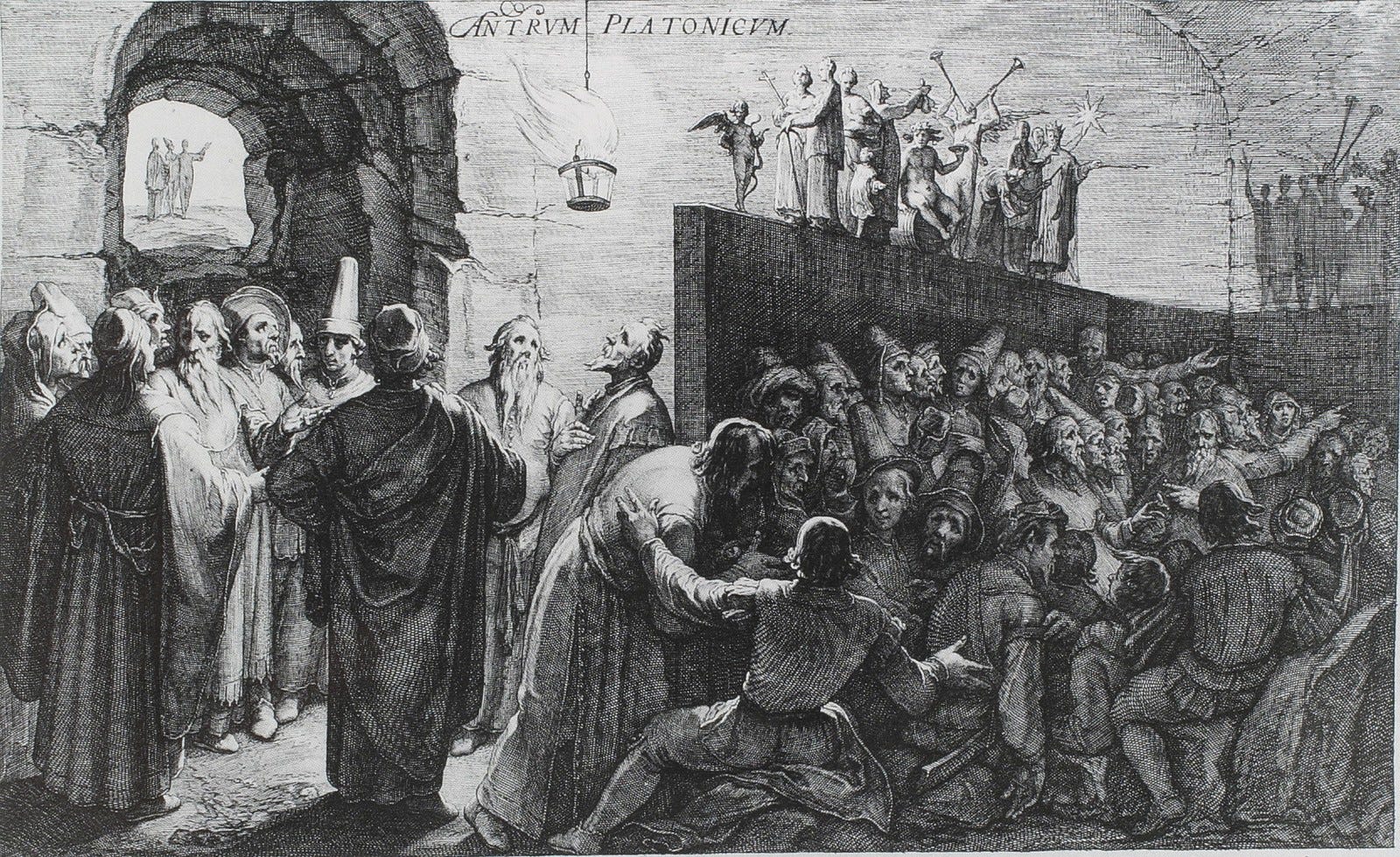
So the question is: what’s the difference between a pagan idol and a Christian icon, assuming a meaningful difference even exists?
Ultimately, the accusation made in scripture is not that the pagans worshipped statues, it’s that they worshipped things of their own creation and that this is no different from worshipping the statues themselves. You can compact this for ease of understanding into “they worship statues” because this is spiritually true.
The fact that the pagans could use the metaphysics of representation does not necessarily mean they always understood it theoretically. The sense that storms, kings, bulls, eagles and the planet Jupiter are manifestations of the same principle is felt before it is understood.
That a pagan priestess can ritually become the person of Ishtar and a Christian priest, the person of Christ is an observed reality first and codified theology second. The question then is whether we are looking at consistencies in the theology of representation or in the phenomenology from which it is derived.
Put another way: did these pre-Christian cultures truly use representation, or did representation use them?
Sophia and Phantasia
The name, Sophia, is usually translated as “wisdom” as in philosophy (philo-sophia, love of wisdom) but it often means something more like technical/practical skill. Here is an ideal definition: the capacity to realize.
This captures its philosophical and practical aspects with a double meaning and brings the ancient word fully into the present.
The fall of Sophia is said to have occurred because Sophia either tried to create or contemplate God without her counterpart, the Logos, which results in the birth of the demiurge. This rhymes with the stories of both Eve and the Mother of God: Eve falls into error and her firstborn builds the first city. Mary does not fall into error and her firstborn, builds the New Jerusalem.
I spoke in a previous post about phantasia, the word often rendered as “imagination” in the writings of the church fathers. It has a meaning very similar to eidos.
The diagram below presents the relationship between the eidolon (middle) and the principle it instantiates (left).
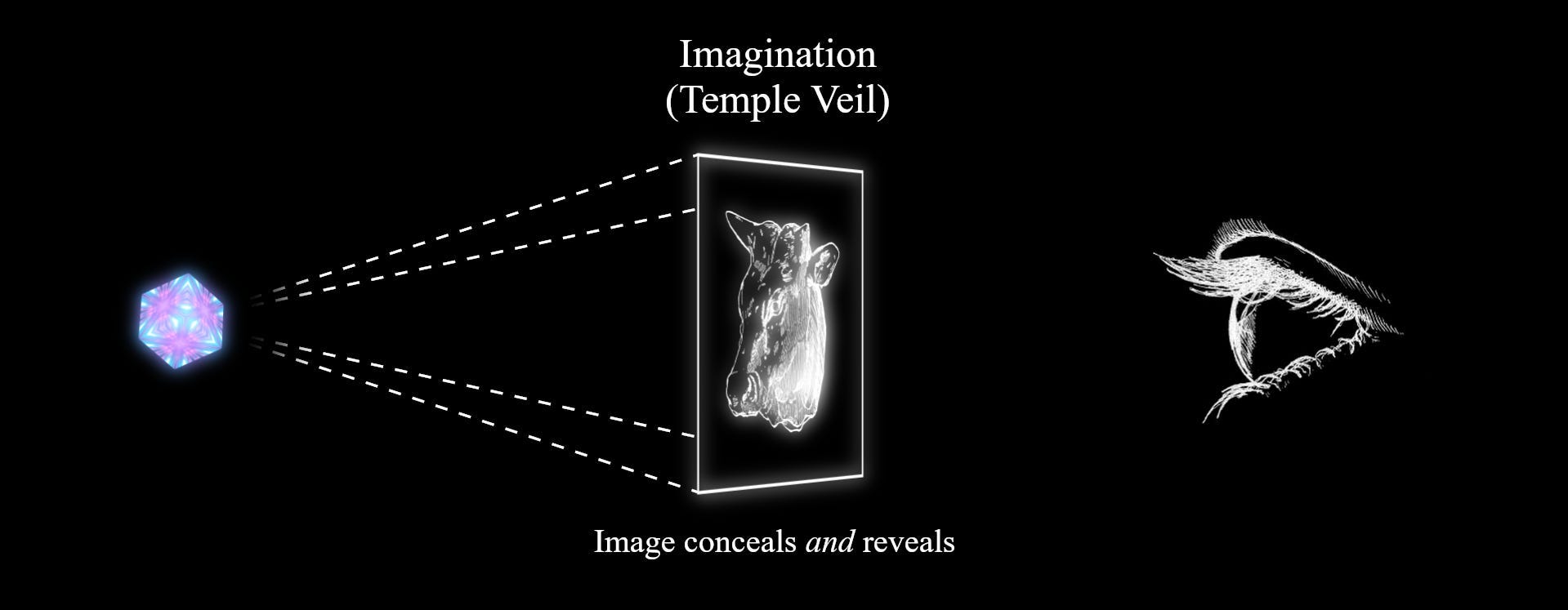
The veil in the temple symbolizes the barrier between humanity and the divine and so it is traditionally said that Mary, who veiled God in the human form is the human embodiment of this veil. The symbolism of the grail and of Christ’s physical body as the temple is the same. Both are barriers around the divine presence. This is related to virginity as a symbol of both protection and wisdom, as it represents preserving the purity of something sacred.


It is through Mary that we see Christ and through the imagination that we “see” the word of God when we read scripture. This is why to “conceive” of something is to hold it in the imagination.
We may say then that Sophia is the imagination in general, whose fall and redemption are revealed in the persons of Eve and Mary respectively. Of course I do not mean to dissolve the distinction between these two, but rather to present them as models of the way the fall and redemption of the individual soul, Sophia, takes place.
Eve is related to phantasia; the image as itself and dissociated from its meaning. The Mother of God is related to revelation; the image as a representation of something greater than itself.
The Snake Gods
In Biblical Hebrew, the word Nahash in Genesis can be read several ways. It can mean “serpent,” but it can also mean “shining one” or “deceiving one” depending on how it is read as there was no notation system for vowels at the time.
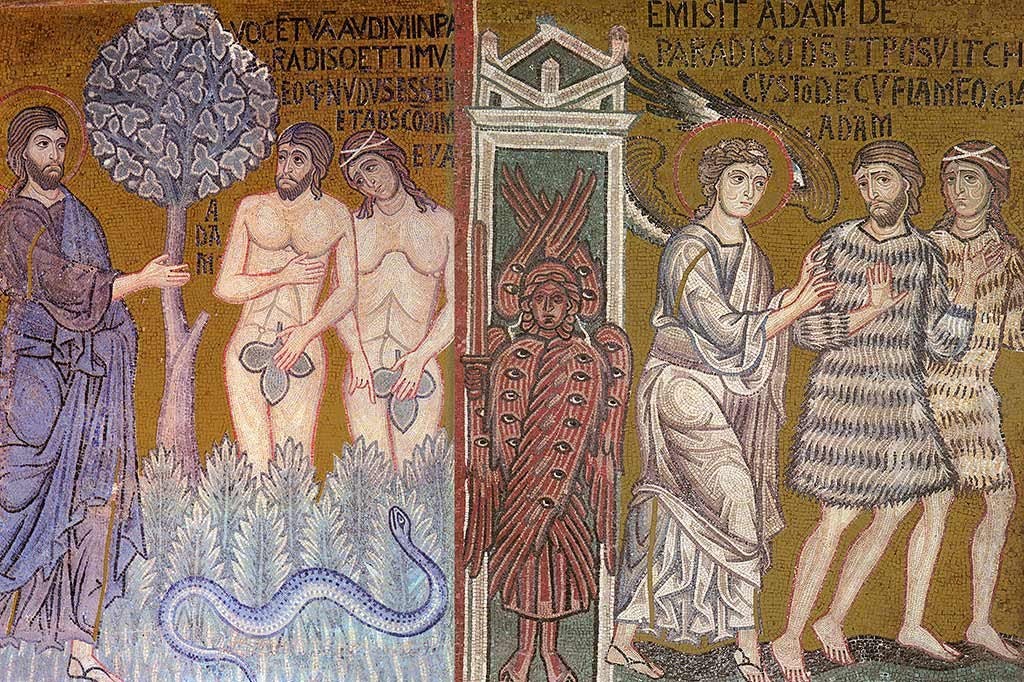
The word “nahash” means to hiss or whisper which is why it is used to refer to both serpents and forms of divination. Nahash is also related to the word nehoshet which, translated, is bronze, copper or brass.
The Hebrew word “saraph,” refers to the “fiery serpents” and the bronze serpent in the book of Numbers, as well as the Seraphim in the book of Isaiah.
The use of bronze in ancient weapons, ornaments and mirrors connects this metal to Azazel, the fallen angel of technology, who instructed humanity in the creation of all three. Copper-based cosmetics like Egyptian Udju, made of Malachite from the mines of Mount Sinai further substantiates this, as Azazel also gave us cosmetics.
Cosmetics, ornamentation and mirrors all relate to the planet Venus, the planet of beauty, traditionally associated with copper. Venus was the morning star who the Romans called “Lucifer,” meaning “shining one.” Copper is also used in electrical wiring. It is one of the main metals in your smartphone, a “black mirror.”
In cosmetics and ornamentation, we see the same occlusion we see in the idols: the manipulation of the image. This is usually done innocently, to beautify — hence the connection to Venus — but when the sensory experience of an image becomes an idol, inspired artistry becomes pure fantasy. One sees this very clearly in Catholic renaissance art, with which the blame solely rests for the “white bearded man enthroned in the sky.”
Though admittedly, it is more technically competent than medieval iconography, it is self-indulgent and worse; noetically distortive. There is of course a place for artistic experimentation, the only problem is that that place is not the Sistine Chapel.
That these styles were often imitating those of glamorous pagan antiquity only seals the point: this is what defines paganism as a spiritual and historical process and it is why people are always drawn back to it in times of decadence. Paganism is that movement from knowledge to excess and entropy represented by Adam and Eve.
The whore of Babylon ties all of these threads together. She rides upon a beast with seven heads, representing Rome. She is called “Mystery” alluding to religious rites and holding a chalice which seems to mean the same. She is adorned in Azazelian ornamentation and drunk — that is, in an altered state. She is a prostitute, the opposite of the virgin and the pejorative most often used for idolaters in the Bible. She is also, of course, named “Babylon” after idolaters.
She is even arrayed in purple and scarlet. These are the same colors of the veil in the tabernacle which hid the Ark of the Covenant described in Exodus 26:31 except for the color blue. The word for blue in this passage is tekhelet which refers specifically to a sky-blue dye obtained from a cerulean mussel.
Tentatively, I will speculate that this sky-blue dye represents Heaven, God’s sapphire throne, while the scarlet represents Earth. The purple, is the union thereof. I suspect this because it is the way my friend Emilee and I both intuitively use these colors.


This suggests that the woman we see riding the beast in Revelation represents an earthly religion that has become separated from the heavenly principle. In the schema presented previously, Heaven would correspond to the higher truths which the eidolons in the imagination are supposed to reveal.
All of this serves to tie these threads together. I plan to apply what has been laid out and talk about this subject in greater depth in the future, but for now I will present this primer which represents my crystallized thoughts on this subject.


In the improv comedy tradition of "Yes and..." I submit that Mystery Babylon is also in some sense the modern Western internet before it is turned totally into an Ahrimanic prison*. And in some sense, the United States, or Lady Liberty--the spirit of the US as a nation, whether conceived of as an emergent phenomenon or as a "principalities and thrones" type spirit. There are images of Columbia, as a drunken goddess on an animal's back, that are semi-officially identified with the Statue of (Lady) Liberty.
*The lady currently rides on and depends for power on, the more beastly, openly dictatorial, worker-exploitative, nations of the earth. When the beast turns on her, and strips her of power, mid-Apocalypse, it is the trap of Ahriman discarding with the bait of Lucifer. This may happen suddenly, and may happen to the prevailing spirit or religion you describe Gryphon, while simultaneously befalling the Western internet that houses its mind, and the nation of the US which houses the bulk of its material base and the bulk of its adherents.
I'd also like to point out that there are more than a few parallels between Mary and Venus. Obviously both feminine divine icons, both associated with the sea and the five pointed star (see stella maris). Roses are also traditionally associated with both of these figures. Devotion to Mary includes praying the Rosary. The Rosary as an object itself shares the same image as the symbol of Venus - circular with a descending line and cross at the bottom.. I feel like there is likely another connection here with the Labyrinth itself (which is distinct from a maze) especially in the context of church cathedrals and pilgrimages. I've heard it said before that beauty can be a bridge to experience the divine, with Mary as the temple veil and Venus as the goddess of beauty, I definitely feel some resonance here. Mary especially is often depicted in a mandorla which is no doubt a feminine symbol, and a symbol of light especially the revelation/bringing forth of light.